
WELCOME
Are you struggling with anxiety, depression, or burnout?
Are you negatively impacted by stressful life events, be they major traumas or an accumulation of small stressors?
You are not alone.
Many people facing these problems benefit from psychological therapy.
Continue reading to find out more.
 |  |  |  |
|---|---|---|---|
 |

ABOUT CATHERINE
Catherine is a Clinical Psychologist with over 15 years experience in the field of psychology. She has a passion for listening to people's experiences and, together, developing greater insight into patterns of unhelpful thoughts and behaviours. Once a collaborative understanding of the problems has been established, Catherine introduces clients to evidence-based psychological therapies that that are specifically tailored to address the needs of each individual. With dedicated effort and commitment, clients are guided to create new, helpful patterns of thoughts, feelings and behaviour.

PROBLEMS WE HELP WITH
-
Anxiety Disorders, including Health Anxiety, PTSD, and Specific Phobias;
-
Depression and other Mood Disorders;
-
Peri-natal & post-natal Anxiety and Depression – in both men and women;
-
Adjustment disorders;
-
Overwhelm and burnout, particularly for helping professionals (e.g., teachers, nurses, doctors, social workers, police, paramedics).
-
Work problems – often seen under Worker's Compensation schemes.
-
Relationship problems (individual therapy, not couples therapy)
NEXT STEPS
Catherine is currently accepting new clients (18+ years) and has appointments available on:
Wednesdays and Thursdays,
8:30am - 2pm (by appointment)
Face-to-face appointments are available in our rooms at
5 Strathalbyn St, Kew East, Victoria.
Telehealth (video) appointments are also available via Zoom for clients living anywhere in Australia.
To make an appointment or for more information please email or call:
catherine.bushnell.psychology@gmail.com
CONTACT US
Location: Level 1, 5 Strathalbyn St, Kew East, VIC 3102
Fax: 03 7048 9973
Please note that this practice is not a crisis service.
If you are experiencing an emergency please call 000 or attend your nearest hospital emergency department.
If you are in distress and need immediate support, please contact Lifeline Australia on 13 11 14, or the Adult Mental Health Service (VIC) on 1300 094 187.
For other support options visit our Helpful Resources section.
WHERE TO FIND US

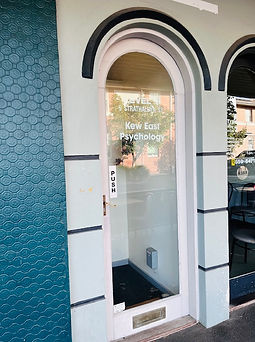
Street parking (free for up to 2 hrs) is available on Strathalbyn St and surrounding streets, and the No.48 tram and 302/304/624 bus stops are only 70-150 metres from our door.
Enter through the glass door titled "Kew East Psychology" (next to Vicky's Restaurant), ascend the stairs to Level 1 and take a seat in the waiting room.
*Please note that, unfortunately, this office does not have a lift or wheelchair access.

FREQUENTLY ASKED QUESTIONS
WHY DO PEOPLE SEE A PSYCHOLOGIST?
People see psychologists for a broad range of reasons, from wanting to learn stress management and communication skills, to dealing with chronic mental health conditions such as Major Depressive Disorder and Post-traumatic Stress Disorder.
WHAT TYPES OF PROBLEMS DO YOU HELP PEOPLE WITH?
At Catherine Bushnell Psychology we enjoy helping clients learn to manage a variety of mental health problems, including:
· Depression
· Bipolar affective disorder
· Anxiety disorders (including Generalised Anxiety, Panic Disorder, Social Phobia, Specific Phobias, PTSD)
· Adjustment Disorders (changes in life situations – e.g., job loss, divorces/separation, retirement, birth of children)
· Grief and loss
· Work stress - including issues under Worker's Compensation/Return to Work claims
· Relationship problems
· Low self-esteem
· Communication problems
WHAT TYPES OF THERAPY DO YOU USE?
Scientific research conducted over the last 100+ years has shown many different psychotherapy approaches to be effective in managing psychological problems. Some of the evidence-based approaches that we use include:
· Cognitive Behavioural Therapy (CBT), including Trauma-focused Cognitive Behavioural Therapy (TF-CBT)
· Acceptance and Commitment Therapy (ACT)
· Mindfulness-Based Cognitive Therapy (MBCT)
· Schema-focused Therapy
HOW CAN THERAPY WITH A PSYCHOLOGIST HELP?
· Science has shown that many mental disorders are linked to the activation of negative neural networks in the brain and unhelpful thinking patterns and behaviour, which can lead people to experience anxiety, depression and other mental health problems.
· Good news: Science shows that psychotherapy can help train our brain's neurons to change the way in which they function, and that by changing our patterns of thought and behaviour we can create healthier neural networks and happier, calmer states of mind.
· Psychotherapy can help you to learn to understand your mind and behaviour and to learn new ways of managing stress. You can also learn to relate to yourself and others in ways that reduce tension and distress. It is important to realise that making changes takes time and effort, and that in order to receive a benefit from psychotherapy you will need to put time into practicing new skills and trying different approaches outside of sessions.
WHAT WILL THERAPY INVOLVE?
At your first appointment your psychologist will ask you questions about the problems you're experiencing and related areas of your life; in subsequent sessions they will work with you to identify your therapy goals and create an individualised treatment plan to address your needs. Ongoing therapy sessions will typically involve a review of the problems you're facing, introduction/review of psychological strategies or information, and plans for between-sessions practice psychological techniques. All therapy approaches used are evidence-based and may include Cognitive Behavioural Therapy (CBT), Acceptance and Commitment Therapy (ACT), Mindfulness, and elements of Dialectical Behaviour Therapy and/or Schema Therapy.
The number of sessions that you attend will depend on the type and complexity of the issue(s) that you wish to address. On average, clients will attend between six and ten 50-minute sessions to address one mental health issue (e.g., Depression, Anxiety). Further sessions may be necessary to address more than one main mental health issue, or if the issue is deeply ingrained (e.g., if it originates from childhood trauma or complex trauma). The number of sessions that you attend will be discussed with you during your initial sessions.
DO I NEED A REFERRAL?
-
You do not need a referral to see a psychologist.
-
Some people are referred to psychologists by their GP under a Mental Health Care Plan, which entitles them to Medicare rebate (of approximately 65% of the full cost) for up to 10 therapy sessions per calendar year.
-
If you have suffered a work-related psychological injury you may be eligible for therapy funding under a Worker's Compensation/Return to Work scheme - see your GP to discuss a referral.
CAN I BRING SOMEONE ELSE WITH ME TO MY PSYCHOLOGY SESSIONS?
-
You are welcome to bring a support person with you to your first session, such as a partner or parent, if this makes you feel more comfortable. In general, however, individual therapy sessions will be conducted with you individually.
-
We ask that adult clients do not bring children with you to sessions, as their presence in the room can impact on what can be discussed and can reduce your ability to concentrate and benefit fully from the session.
WHAT HAPPENS IF I NEED A REPORT FROM MY PSYCHOLOGIST?
If you require a diagnostic assessment for the purpose of a report it is important that you tell us prior to your first appointment. A diagnostic assessment for the purposes of a report can require additional psychological tests and assessment and will usually take several sessions to complete. Please note that Medicare does not provide a rebate for sessions that are for the purpose of diagnostic assessment or reports. Diagnostic reports incur additional fees that are charged proportionate to the time that the report takes to write.
HELPFUL RESOURCES
Free Self-help resources from the Centre for Clinical Interventions:
https://www.cci.health.wa.gov.au/Resources/Overview
Free phone counselling support options: https://www.mentalhealthaustralia.org.au/need-help/
Low/no-cost counselling options (in Victoria):
12-25 yrs https://headspace.org.au/
26+ yrs https://www.betterhealth.vic.gov.au/mental-health-wellbeing-locals
